
Key Takeaways
- A clean office supports employee comfort, confidence, focus, and a positive visitor experience.
- The best cleaning schedules reflect actual occupancy, foot traffic, shared spaces, and operating hours.
- Restrooms, kitchens, touchpoints, floors, and shared technology all require different routines.
- Cleaning, sanitizing, and disinfecting have different purposes and should be used appropriately.
- Surface care, dust control, ventilation, and safe product use all contribute to a healthier indoor environment.
A strong office cleaning plan does more than make a workplace look presentable. It helps teams move through the day with fewer distractions, supports a welcoming environment for visitors, and gives facility managers a clearer way to maintain shared spaces. For businesses comparing commercial office cleaning in Bristol, CNS Cleaning Company provides a useful local example. The company has operated since 1983 and offers customized cleaning plans for offices in Bristol, Pennsylvania, restroom and breakroom care, common-area cleaning, floor maintenance, flexible scheduling, and ongoing quality checks.
The right approach is not a generic checklist performed at the same frequency everywhere. A quiet office with assigned desks has different needs from a busy hybrid workplace where meeting rooms, shared workstations, kitchens, and reception areas experience changing traffic throughout the week.
Why Office Cleanliness Matters
Office cleanliness affects both daily operations and appearance. Overflowing trash, streaked glass, unpleasant odors, dusty surfaces, and poorly stocked restrooms can interrupt employees and leave visitors with the impression that details are overlooked. In contrast, a maintained workplace makes it easier for people to focus on meetings, client service, and their own responsibilities.
Hybrid schedules add another challenge. A space may be nearly empty on Monday, then host a full in-office team and several client meetings on Tuesday. Cleaning plans should account for those peaks rather than relying solely on square footage. For example, a conference room might need attention after every high-attendance meeting, while a lightly used storage room may only need routine weekly service.
Cleaning and Workplace Health
Cleaning, sanitizing, and disinfecting are related but distinct practices. Cleaning removes visible soil, dust, and many germs through soap, water, and physical action. Sanitizing reduces germs to levels considered safe under applicable standards. Disinfecting uses products designed to kill remaining germs on a properly cleaned surface. The CDC’s guidance on cleaning and disinfecting emphasizes regular cleaning of high-touch surfaces and targeted disinfection when someone has been sick or when the situation calls for it.
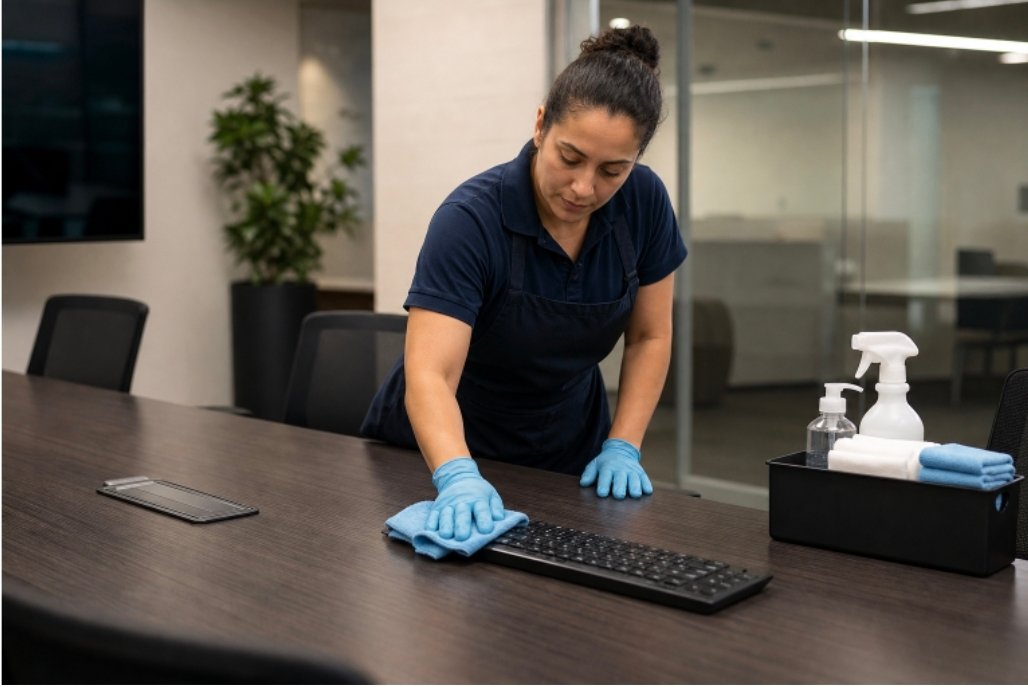
Common office touchpoints include door handles, elevator buttons, faucet controls, appliance handles, shared keyboards, phones, desk surfaces, and conference tables. Staff should follow product labels, including the required contact time, ventilation instructions, and any guidance on personal protective equipment. Cleaning is an important part of workplace hygiene, but it cannot prevent every illness on its own.
Cleanliness and Productivity
A cluttered, dirty, or poorly maintained office can create avoidable friction. Employees may waste time searching for supplies, moving around spills, reporting restroom issues, or preparing a meeting room that should have been ready. Clean breakrooms and reliable trash removal also help prevent small inconveniences from becoming recurring complaints.
Cleanliness can support morale because it signals that the organization takes employee comfort seriously. Still, it is only one factor in a productive workplace. Good management, clear expectations, workable technology, ventilation, and healthy policies matter too. A cleaning plan should support those broader efforts rather than be treated as a complete solution.
Office Areas That Need the Most Attention
Workstations and Shared Desks
Assigned desks may need regular dusting, trash removal, and surface care. Shared desks need more frequent attention, especially when employees rotate through them. Clean carefully around monitors, keyboards, and other electronics using methods appropriate for the equipment. Establish a simple process for employees to report spills, full bins, or damaged supplies.
Restrooms and Breakrooms
These areas usually require the most consistent service. Restrooms should be cleaned, dried, and restocked based on actual use. Breakrooms need attention to counters, sinks, tables, appliance handles, food residue, and waste. Busy periods may call for mid-day checks rather than a single after-hours visit.
Meeting Rooms and Reception Areas
Reception spaces shape first impressions, while meeting rooms need to be ready for the next group. Prioritize tables, chairs, glass, entryways, shared controls, and bins. When a room hosts large meetings or client presentations, schedule a quick reset between uses if practical.
Floors, Carpets, and Upholstery
Floor care should match traffic levels. Entrances and corridors often need frequent spot cleaning, while carpets benefit from routine vacuuming and periodic deep cleaning. Address spills promptly to reduce staining, slip risks, and lingering odors. Upholstered furniture and soft surfaces can also collect dust over time.
Building a Practical Cleaning Schedule
Begin with a walk-through and map each area by traffic, purpose, and risk of becoming visibly untidy. Then assign tasks by frequency.
- Daily: Clean restrooms, check supplies, remove trash and recycling, wipe breakroom surfaces, address touchpoints, and spot-clean entrances and common areas.
- Weekly: Perform detailed dusting, clean glass and entryways, provide more thorough floor care, service lesser-used rooms, and review recurring issues.
- Monthly or seasonally: Schedule carpet extraction, deeper floor treatments, high dusting, upholstery care, and detailed service after events, renovations, or office moves.
Revisit the schedule whenever occupancy changes. A plan built for five office days may be inefficient for a three-day hybrid schedule, while an expanding team may need more restroom checks, trash service, and meeting-room turnover.
Cleaning and Indoor Air Quality
Surface cleaning is one part of a healthier indoor environment. Dust can gather on blinds, furniture, vents, carpets, and other soft surfaces, while cleaning products can introduce odors or other pollutants if used incorrectly. The EPA’s office indoor air quality guidance explains why ventilation, building operations, and occupant comfort should be considered together.
Use products according to their labels, never mix chemicals, and provide adequate ventilation during and after cleaning. Facility managers should coordinate cleaning routines with HVAC maintenance and building management, particularly when employees report persistent odors, excess dust, or comfort concerns. Lower-emission products may be appropriate when they meet the space’s cleaning requirements.
Choosing a Cleaning Provider
When comparing providers, look beyond the quoted price. Ask for a clear scope of work that explains which tasks are included, how often they occur, and how quality will be measured. A dependable provider should also explain staff training, supervision, safety practices, communication procedures, and the process for correcting missed work.
- Confirm that the provider can work around after-hours, daytime, weekend, or event-based needs.
- Ask how inspections are documented and how service concerns are tracked.
- Review the products and equipment used for different surfaces.
- Understand contract terms, service limits, cancellation rules, and any extra charges before signing.
Office Cleaning Review Checklist
- Are high-touch surfaces cleaned on a regular schedule?
- Are restrooms clean, dry, stocked, and checked during busy periods?
- Are breakrooms free from food residue, odors, and overflowing bins?
- Are meeting rooms ready for the next group?
- Do floor and carpet routines match traffic levels?
- Are products labeled, stored, and used safely?
- Can employees easily report missed tasks or concerns?
- Does timely corrective action follow inspections
Final Thoughts
An effective office cleaning plan is consistent, practical, and tailored to the way people actually use the workplace. Focus on health, safety, air quality, communication, and measurable standards. When the plan reflects actual occupancy and priorities, cleaning becomes a reliable part of smooth daily operations rather than a problem employees have to manage.